

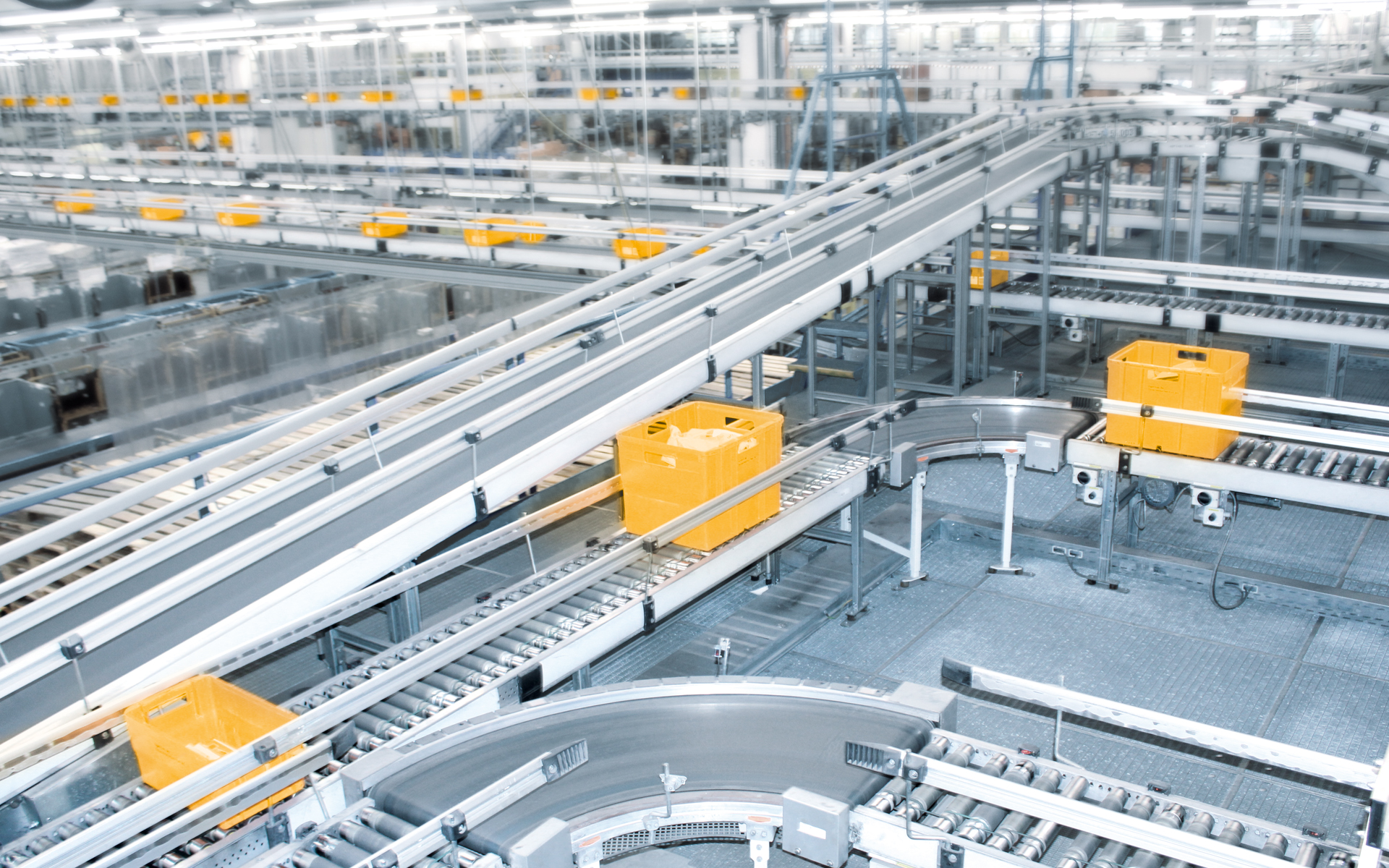
In automated and increasingly individualised production environments, complex plants must be assembled in ever shorter times, while the number of components to be installed continues to rise. One aspect is particularly relevant: end-to-end connectivity. Plant and machinery must be connected in such a way that the entire production system operates efficiently and safely. The communication protocol IO-Link Safety ensures a flexible, smarter and more cost-effective connection.
Essentially, IO-Link Safety is a technology that enables the quick, easy integration of safety sensors and actuators. This offers particular advantages in complex plants, such as extensive conveyor systems.
Safe standard for industrial communication
Any manufacturer and system builder that develops and produces large-scale conveyor systems knows how time-consuming the wiring can be. Each station – whether it’s an emergency stop button, a pushbutton or a status indicator on an IO-Link light for example – usually requires separate wiring to control cabinets or decentralised modules and a corresponding evaluation by the controller (standard or safety). This level of complexity not only slows the project down, but also increases costs, creates more potential error sources and makes maintenance more difficult. In contrast, IO-Link Safety saves machine builders time by using a single cable connection, capable of handling both communication and safety. That’s because IO-Link Safety can drastically reduce the installation time — and therefore also the engineering work.
Faster assembly for a faster flow of goods
Conveyors, for example, ideally need to transport material quickly and efficiently, i.e. without any major disruption. This means that manufacturers, system builders and operators of conveyor systems are often under considerable time pressure because the conveyors must be up and running quickly, while at the same time production logistics must remain secured during operation. Strict requirements that IO-Link Safety meets: with plug-and-play wiring and a range of up to 20 metres from the IO-Link Safety Master to the IO-Link Safety Devices – IOLS sensors and/or IOLS control units panels – in the field. Applications can be brought into service more quickly thanks to M12 plug-in connectors and simplified device configuration. If the control unit PITgatebox IOLS is used as an IOLS device with a point-to-point connection to the Master, the range can be even greater. This makes it much easier to design the layout of conveyor systems, for example, and frees integrators from the typical infrastructural constraints of hard-wired safety devices.
Such a high degree of flexibility in the infrastructure simplifies layout planning considerably, as it is freed from the traditional limitations of hard-wired safety systems. Another advantage is that the IO-Link Safety Master can also be used in rugged environments thanks to IP67 and IP69K protection – in metalworking for example, where dust or swarf are commonplace.
An installation example illustrates how IO-Link Safety can easily connect the Master over long conveyor lines with 40 to 50 control points.
Benefits of IO-Link Safety in a nutshell
This reduces the installation time of safety devices on conveyor systems from days to hours. This is because IO-Link Safety Devices can be connected directly via standardised plug-in connectors.
On-site installation in the field, even under industrial conditions, eliminates the need for cost-intensive decentralised control cabinets.
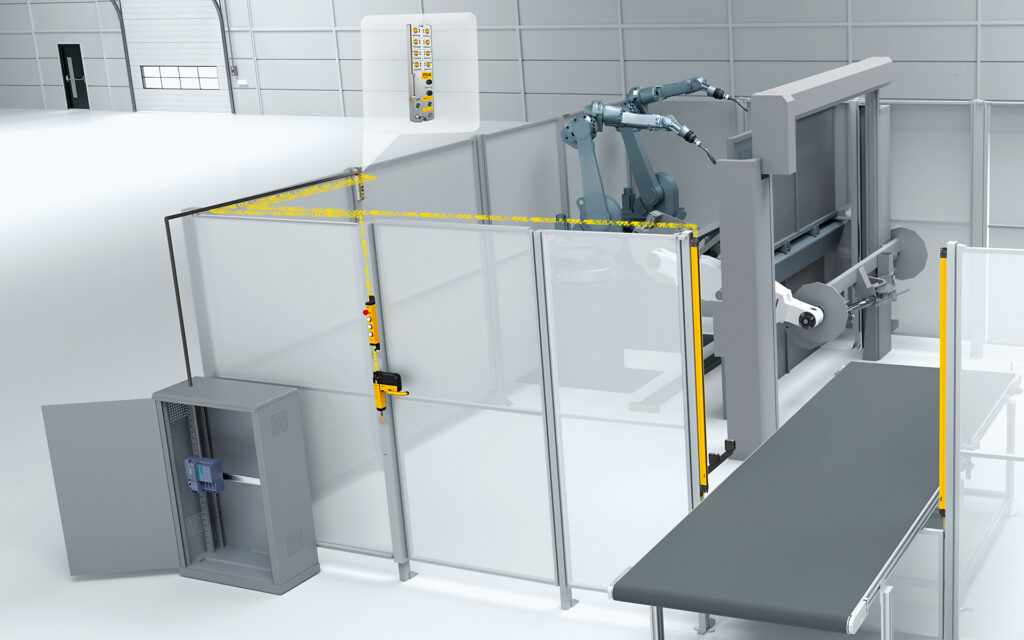
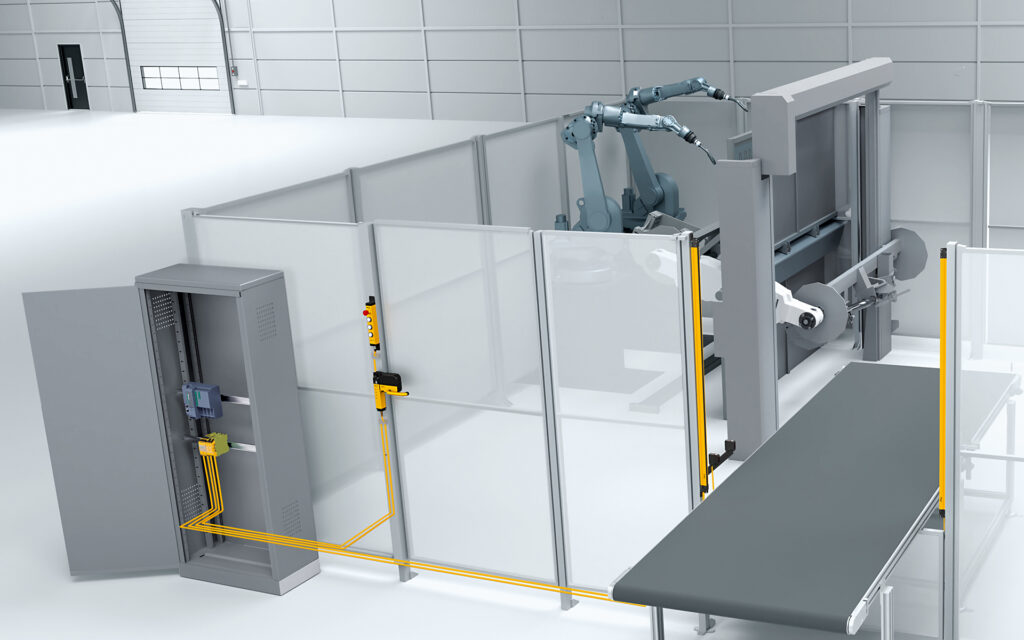
IO-Link Safety devices can be connected directly via standardised plug-in connections. © Pilz GmbH & Co. KG, Ostfildern
IO-Link Safety – Systematically more efficient
In many cases, plant and machinery also require safety switches or safety locking devices to protect both human and machine. IO-Link Safety enables seamless integration of such safe sensors in the field. In the Pilz IO-Link Safety system, for example, the sensors connected via the IO-Link Safety control unit PITgatebox offer additional advantages: via IO-Link Safety, the status of the gates and protection devices – such as “open” or “closed” – is transmitted centrally to the higher-level safety controller. This enables the plant to restart more quickly and the reaction time to be optimised when it comes to maintenance. When users employ the safety locking device PSENmlock and the control unit PITgatebox from Pilz’s IO-Link Safety system, they can implement predictive maintenance – by recording operating hours – and advanced diagnostics. This is because users can easily record the status messages from the safety locking device via the system.
The complete IO-Link Safety system from Pilz, including certified Master, ensures reliable and secure safety gate management.
How to connect control units and sensors more quickly?
This relatively new technology, which enables control units and sensors in the field to be connected quickly and easily, provides tangible support for users. It makes immediate diagnostics possible on emergency stop switches, pushbuttons and LED indicators. As such it enables users to react in an ad hoc manner should faults occur. IO-Link Safety always has cost optimisation in mind. The IO-Link Safety Master from Pilz requires just a single port to connect to the control unit PITgatebox available within the system. If additional sensors such as safety switches or guard locking devices are then integrated in series to this control unit, all communication continues via this single IO-Link-Safety port – it’s clear and there’s no need for additional wiring. The fact that even complex plants can be commissioned much more quickly is a further economic advantage. This is because IO-Link Safety simplifies installation and makes the communication structure less error-prone. The reduced commissioning time is just one aspect; the ability to exchange devices quickly is another. Anyone using IO-Link Safety can exchange all devices almost immediately. IO-Link Safety devices can identify themselves automatically; stored parameters are transferred automatically. This feature makes them easier to exchange. And reduces storage costs, as fewer product types are required.
Optimised fault diagnostics via IO-Link Safety
Control units enable commands for safety gate systems such as activate, stop or reset. Particularly in the case of extensive, large-scale plants, it should be possible to activate or control individual machine functions directly at the point of use. That’s because, in this case, swift action can only be effective if it is part of an immediate, coordinated response. It is therefore beneficial to connect control units in series and also have them integrated via IO-Link Safety. Without IO-Link Safety, the control units must be wired and analysed individually. The difference lies in the series connection of the control units and in the data diagnostics. Without IO-Link Safety, data such as whether or not an emergency stop has been operated is available. With IO-Link Safety, you have access to significantly more diagnostic data. For example, information on the status of the device in the field – such as whether it is flashing or lit – or, in the event of an error, the error code or, for example, the product name and ID. This information on the device status tells the operator whether the machinery has stopped, for example. So it shows them what to do. With Pilz, it is also possible to carry out centralised diagnostics on all control units PITgatebox, for example. This means that the information is displayed centrally on the visualisation system and not just on the plant.
Conclusion: As production lines become increasingly complex, conventional wiring and safety architectures are often unable to keep up. With IO-Link Safety, the market has a system that meets this requirement.

