


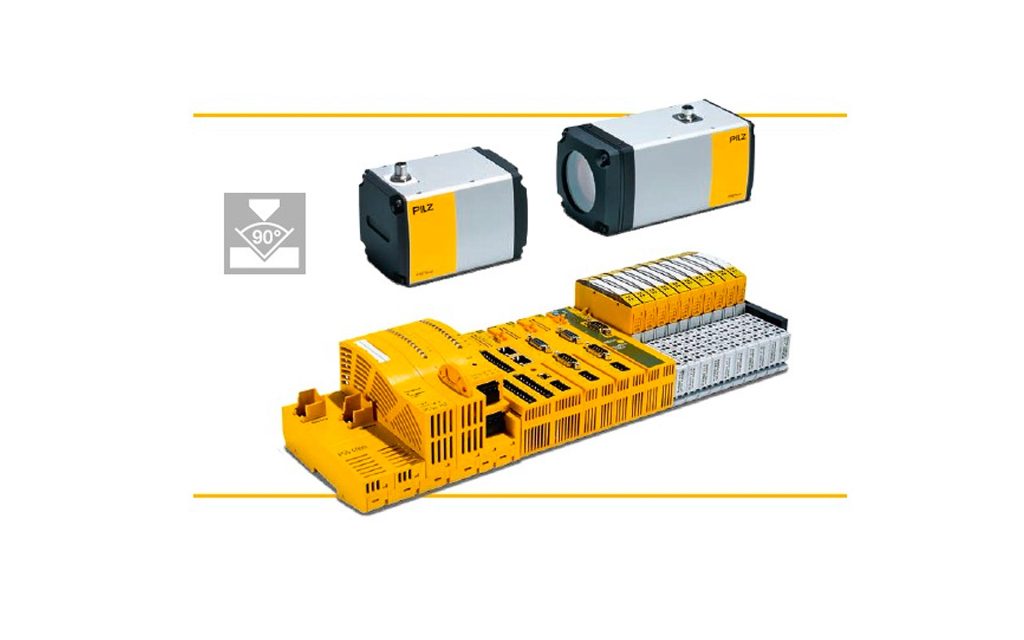
In the press brakes from the press manufacturer Bystronic, the camera-based protection system PSENvip has for years been used in combination with the automation system PSS 4000 from Pilz to ensure safe, efficient and user-friendly processes. With the module for bending angle measurement for PSENvip 2 newly developed by Pilz, Bystronic is once again expanding the scope of its safety system.
The tools that are often used on press brakes tend to push conventional safety devices to their limits for various reasons. Especially on compact machinery: space is in short supply. Not with PSENvip 2 – the size of the receiver module is reduced by about half.
Special use for protection
In line with the standard EN 12622, each bending line must be protected by a protected field that is positioned in the factory at least 15 mm in front. The challenge and requirement in complying with the normative specification is that the tool is completely within the protection system’s field of vision. PSENvip and the second, extended generation PSENvip 2 meet these standard specifications. In combination with the automation system PSS 4000, the integrated “Fast Analysis Unit” guarantees shutdown times of under one millisecond and the shortest stopping distances for the press brake tool. The press brake is thus safe, even at very high speeds. “The simple handling, the high reliability and the resulting achievable increase in productivity and machine availability are the major reasons why we have relied on the PSENvip protection system for the Xpert series for years,” emphasises Karsten Trautvetter, responsible for product management at Bystronic.
Observer with precision values
Close customer contact and knowledge about current needs and requirements on the user side are constant drivers of innovation at Bystronic. “The newly developed module for bending angle measurement from Pilz that is unique in this form and can be easily integrated in the camera-based protection system PSENvip 2 came at exactly the right time,” states Karsten Trautvetter. PSENvip is particularly advantageous for small press brakes with short bending lengths and no room for any measuring equipment to be installed. The camera system is installed at the side on the upper die and determines the measurement data; the bending angle module evaluates all determined measurement data on the bending contour of the sheet and provides it to the machine visualisation via a standard interface.
The image data transmitted to the control system directly shows the operating personnel the current angle measurement on the operating display during press braking. This enables a fast and efficient check of the achieved bending angle. Laborious manual measurements or expensive angle measurement systems that take up space are not needed. The technological basis for meeting the high normative specifications are powerful optics with LED light as well as the robust design of the protection system which is insensitive to reflections as well as external and stray light. “As was already the case with the predecessor, with PSENvip 2 installation, configuration and commissioning can also be easily performed directly via a web interface,” adds Karsten Trautvetter.
“Low speed” phase as highlight
An effective contribution to increasing productivity is also made by dynamic muting: With a conventional muting procedure, the upper tool consistently moves the last millimetres at the permissible safe speed of 10 mm per second. With dynamic muting of the protection system PSENvip 2 in combination with the “Fast Analysis Unit”, the upper tool dynamically reduces its speed to a minimum from the initial 300 mm per second across a “slow route”. The press brake tool does not travel at “low speed” until the last millimetre before making contact with the workpiece. “Low speed” is thus the guarantee for “fast” press brakes: “By using camera-based protection system PSENvip 2 and automation system PSS 4000, we have verifiably increased the productivity of our press brakes by around 20 percent,” claims Karsten Trautvetter. “Compared to models with comparable pressing force, our press brakes are more responsive and more efficient!”

 Loading...